Showing posts with label Reading. Show all posts

Tuesday, April 10, 2018

Reading Notes: Nivedita's Shiva, Part B

I think I preferred this storytelling style to the one in Part A of this week's reading, as I felt like I was more able to follow the story and get a clearer picture of Shiva.  Since it is longer bursts, I decided I'd do my notes in bullet format for this reading.

The Story of Shiva, the Great God
By: Sister Nivedita

  • Shiva's favorite places are wild and lonely places
  • He doesn't appear to be a god, he dresses as a lowly traveler with matted hair and a begging bowl
  • Constantly rapt in meditation
  • His one true desire is to destroy the ignorance of souls and let light come
  • He has infinite compassion, desiring to reveal the cause of sin and error to men so that they may overcome
  • Only keeps devotees who call themselves masterless
  • Rides on a shabby old bull rather than a horse or elephant 
  • Regards the lame and crooked and blind as his own - loneliness and deformity and poverty are passwords to his heart
  • His third eye pierces to the heart of all hypocrisy and he can burn anything untrue to ash in a glance with it
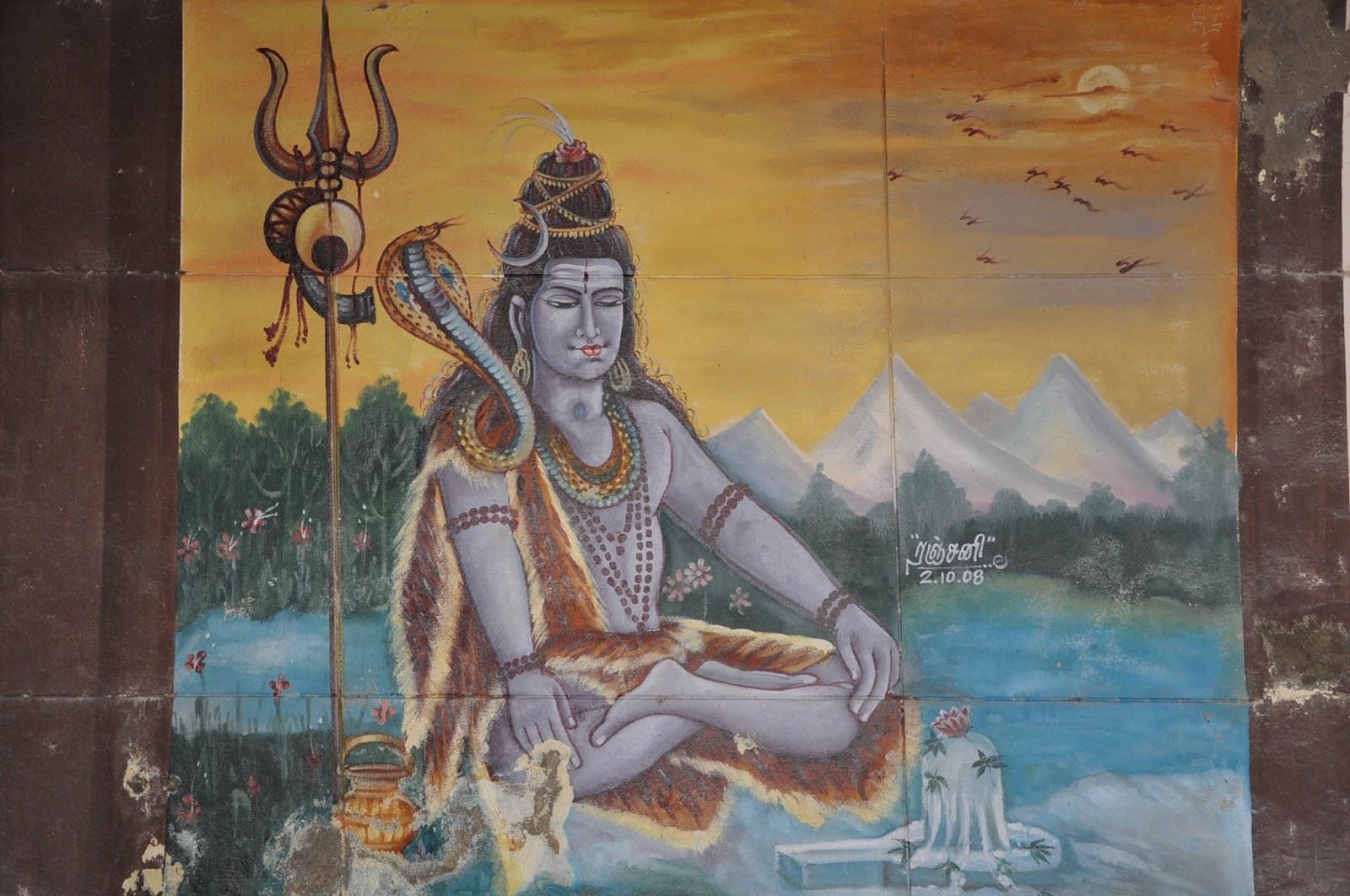
(Shiva meditating; Image Source)

By: Sister Nivedita
  • Duksha hates Shiva because Shiva would not bow to him, but in reality, he was protecting him, because it is a great curse when someone mightier than another bows at the weaker one's feet. Shiva thought he was respecting Duksha, but Duksha took it as a mighty insult
  • Sati means being and existence, proving her goodness because "nothing really exists but goodness"
  • Her heart was devoted to Shiva, but their love was forbidden by Duksha. However, at her swayamvara, Shiva wins her hand and Duksha has no choice
  • Duksha exiles his daughter and Shiva takes her away
  • Sati is angered when she finds out that her father is holding a feast and she and Shiva weren't invited. Shiva begs her not to go to him, but she does anyways
  • After a mighty fight between Sati and Duksha, she drops dead
  • Shiva's wrath burns and he wages war. He chooses not to kill Duksha, but to put a goat head on his human body.
  • He caries Sati's body across the earth as Vishnu follows and breaks her body into pieces so he can have peace
  • Sati is born again in Uma/Parvati

Reading Notes: Nivedita's Shiva, Part A

Sati
By: Sister Nivedita
Sati was the youngest daughter of the chief of the gods, Daksha. She became Shiva's wife, but that was unpleasing for her father, Daksha, because he did not like Shiva. However, Daksha was coerced into allowing the marriage when he held Sati's swayamvara and Shiva won her hand. Later down the road, Dakhsa holds a festival without inviting Shiva. This insults Sati greatly and she confronts her father, grows very angry, and falls dead at his feet.

The Anger of Shiva
By: Sister Nivedita
Shiva is seriously angry when he hears about Sati. He births a demon from a lock of his hair and ordrs it to lead his army against Daksha. Brahma advises all the gods to make peace with Shiva because he could easily destroy the entire universe. After speaking to Brahma, Shiva decides to give Daksha a goat head and to restore his broken limbs. We're reminded that Shiva, Vishnu, and Brahma are a trinity, not their own sole entities. They are three in one. 

By: Sister Nivedita
Shiva carries Sati's body across the earth, his sorrow destroying nature with every step he takes. Vishnu is trailing behind him, restoring the earth and slowly cutting up Sati's body so that Shiva is carrying less and less weight. Once the weight is gone, Shiva retires alone to keep to himself in meditation. We learn that Sati's body was cut into 52 pieces, which is tied to the 52 weeks of the year. 

(Shiva carrying Sati's body, with Vishnu close behind; Image Source)

By: Sister Nivedita
As I read more stories about these gods, the more they remind me of the gods of Greek and Roman mythology I'm more familiar with. Shiva is making one rash decision after another. Here, he grows angry with Parvati because she daydreams while he's explaining a difficult Veda to her, and casts her to earth to be a fisherman's wife. He quickly realizes he has made a mistake because Parvati is his love and she should only be with him. Years pass and when Parvati's fisherman father declares that whoever can capture the treacherous shark causing mischievous will marry his daughter, Shiva takes his chance and wins his wife back. A rash decision caused years of trouble, which is a common theme when it comes to mythology. 

By: Sister Nivedita
Shiva learns of 10,000 rishis who were teaching that souls have no god and salvation is achieved through works rather than faith. He decides he needs to teach them the truth, so he and Vishnu enter the forest disguised as a wandering yogi and his wife. The rishis soon realize something is wrong so they begin to cast curse after curse, but Shiva easily knocks down each challenge. When they send a great goblin after him, he begans to dance on the goblin's back. The rishis realize that they are in the presence of a god and give themselves to his worship. 

Monday, April 9, 2018

Reading Notes: Inayat Jatakas, Part B

The Patient Buffalo
By: Noor InayatA buffalo was sleeping under a tree when a mischievous monkey decided to bother him. Time after time, the monkey bothered the buffalo and caused him hardship, but the buffalo did not slay him (although he easily could have). The buffalo recognized the monkey had a small brain and he didn't want to harm him just so he could live happily. A fairy got rid of the monkey and blessed the buffalo so nobody could every bother him again.

(The patient buffalo; Image Source)

The Great Elephant
By: Noor Inayat
A beautiful elephant lived in an oasis all alone when he heard voices one day. The voices are those of men who have been exiled by their king and are starving and thirsty. He points them to a hill where he says an elephant is there to feed them. He runs on a different path so the travelers won't see him and he jumps from the highest point on the mountain to his death so that he can feed the travelers. Once the travelers recognized his sacrifice, they were hesitant to eat the elephant, but didn't want his death to be in vain. His sacrifice sustained them until they could reach the next town where they lived happily. 

By: Noor Inayat
Seven quail siblings are being raised in a fire, but one of them only ate grass and did not grow strong and mighty wings. A forest fire comes and the parent quails with the six other children fly away, but the seventh is stuck in the nest. He commands the fire to leave him alone and be just, and the fire avoids him just like that. 

By: Noor Inayat
The king's knight rode on a mighty horse to defeat the seven invading kings who were trying to take over the kingdom. Before the seventh king, the horse was injured and the knight moved to take another horse, but the horse told him that he would never survive on another. His wounds are bandaged and he is ridden into the final battle, which is excruciating for him. After claiming victory, the horse asks the king to not kill the prisoners, but to let them go under vow to never attack again. The horse succumbs to his wounds, but he was remembered for his nobility. 

Reading Notes: Inayat Jatakas, Part A

The Guilty Dogs
By: Noor Inayat
The royal dogs were naughty and chewed up the king's harnesses for his horses, but the king doesn't realize it was them. He orders all the dogs of the city to be killed, except for his own royal dogs. When the chief of the dogs hears this he goes to the king and demands justice, explaining that the royal dogs are the guilty one. Those dogs are made to vomit and are proven to be guilty, and the king immediately retracts his order and takes good care of the city's dogs.

The Fairy and the Hare
By: Noor Inayat
The hare and his friends decide that they will fast for a day and give any food they find to the poor and needy. The three friends steal food to give away, but the hare has nothing so he decides that he will give his own body up to eat if someone passes by. A cruel fairy takes advantage of the situation and disguises herself as a beggar to coerce the hare into giving his life. Luckily, the hare jumps into the flames but they are cool and did not burn him.

The Golden Feathers
By: Noor Inayat
A poor man leaves his family to go find money, when he stumbles across a fairy who turns him into a goose with golden feathers. He goes back to his wife (of course, she doesn't know it's him), and tells her to pick one of his feathers and go sell it and that he will come back every day. This continues for some time and the wife is doing quite well for herself. One day, she gets greedy and decides to fully pluck the goose. However, an enchantment was placed that if the goose was ever stripped completely, his feathers would no longer be gold, so they all turned white and the wife had nothing. Her greed prevented her from getting anything. 

(The goose after only white feathers 
grew back; Image Source)

By: Noor Inayat
A master encourages his students to go to a place where no one is watching and steal money to sustain him. All of his pupils jump to it except one, who says that even when no other people are around, his own self is watching and he would rather beg than watch himself steal. The master was happy at his student's understanding of his task. 

Reading Notes: Rouse Jatakas, Part B

Spend a Pound to Win a Penny
By: W. H. D. Rouse
A monkey steals a bunch of peas from men below his trees while they tend to their horses, but then accidentally drops one. He is in such a greedy state that he goes after that one pea without realizing that all of the other ones are falling in the process. He searches and searches for the one pea until the men come back and throw stones at him, and not until he clambers back up his tree does he realize that he lost everything else. Instead of being so consumed with one thing that went wrong, he should've focused on everything else he had.

Union is Strength
By: W. H. D. Rouse
A hunter lures quails to him by imitating their call, and then netting them all when they gather. The quails begin to work together to fly all at once and take the net with them, then escape from it later by landing on a bush where the net gets caught. The hunter begins to worry because he's not getting any sustenance, but he figures that the quails will soon begin to quarrel and argue. Sure enough, a petty argument begins and the quails no longer work together, allowing the hunter to kill them and eat them all. 

By: W. H. D. Rouse
It's actually kind of sad to read all of these Indian stories written in the past when animals like lions and elephants were so prevalent in the area, but now lions are confined to few parts of Africa and elephants have had such drastic decreases. The conservationist in me is saddened about how the animals that once inspired these stories are no longer in the areas they were written. In this story, a jackal proposes to a lioness and offends her greatly. She was insulted that a measly jackal would have the gall to propose to a queen like her. Her first two brothers get offended quickly and go after the jackal, but die when they try to jump at him while disregarding the crystal. The third brother realizes there is crystal protecting the jackal and scares him to death just by calling out to him. The sister is not at all sorry about her two brothers having lost their lives, along with the jackal who really didn't try to cause harm. Nobody else ever proposed marriage to her because she was so snotty. 

(The haughty lioness; Image Source)
By: W. H. D. Rouse
Three little boys want to persuade a gardener who has no nose to give them some flowers to take home. The first two boys try to flatter the gardener but end up insulting him about his nose. Because they beat around the bush and were trying to please their way into getting what they wanted, they ended up being rude and didn't get anything at all. The third boy simply asks for a posy and the gardener is so pleased that he doesn't have any tricks up his sleeve and is simply honest that he sends the boy home with a bunch of flowers. 

Reading Notes: Rouse Jatakas, Part A

The Giant Crab
By: W. H. D. Rouse
This story is about a monstrous crab who tortures all the animals coming to one of the only lakes around to drink. He kills the innocent animals and feasts on them until a pair of elephants decides they've had enough and they trick him then kill him. I pictured the crab as Tamatoa from Moana, a giant crab who is only out to benefit himself and doesn't care about anyone else!
(Tamatoa; Image Source)

By: W. H. D. Rouse
A man steals his friend's plough to sell as his own, and when his friend finds out he takes matters into his own hands. He takes the dishonest friend's son for a "walk" where he actually places him in the home of another friend, but tells the father that the son was taken away by a hawk. Of course, the dishonest man knows a hawk didn't steal his son, but the man uses this to make his point that obviously a rat didn't eat his plough. In the end, the dishonest man returns the plough, gets his son back, and learns that he should be more honest. 

By: W. H. D. Rouse
A farmer takes a liking to a resident mouse, bringing him dinner every night and enjoying his companionship. When the farmer's cat tries to kill the mouse, the mouse makes a deal that he'll bring the cat juicy meat every night in exchange for not eating him. The mouse grows skinnier and skinnier and when the farmer notices, he decides to kill the cat rather than coming up with some other solution like giving the mouse and the cat both meat. A little extreme.

By: W. H. D. Rouse
This story is actually pretty deep, talking about the problem of people pretending to be pious and put on a holier-than-thou act, when in reality they go back to their own ways in the snap of a finger. The wolf claims he's going to fast and is so holy, but the second a temptation comes forward he turns into his normal self. 

Wednesday, April 4, 2018

Reading Notes: Babbitt's Jataka Tales Part B

The Elephant Girly-Face
By: Ellen C. Babbitt
An elephant hears bad men talking about killing and being mean, so he resorts to killing the keepers and being very cruel. Upon discovering this, the king sends mean to talk kindly near him, and the elephant reverts to its kind ways. This story has a two-fold meaning, first showing the influence our talk and action has on others. We must be cautious, especially around the impressionable, to not sway them to do our bidding. Second, we must be wise in not falling prey to doing whatever we hear around us, the elephant was only doing what he heard, but that didn't make it right.

The King's White Elephant
By: Ellen C. Babbitt
After the carpenters help an elephant with his injury, he helps them with their work every day and his son, the white elephant, is raised to do the same. Because of this, they both get a good and full life and then his son ends up as a prized possession of the king. They repaid their debt and it worked in their favor in the end.

Granny's Blackie
By: Ellen C. Babbitt
Blackie sees that Granny is growing old and feeble, so instead of playing with the children like he liked to do, he goes off to find work. He gets paid a good price for moving wagons across the river and makes sure to get fair pay to take home and surprise Granny. Blackie is happy that he cvan help Granny and makes sure to work hard to help her live comfortably.

(Blackie going to find work; Image Source)

Monday, April 2, 2018

Reading Notes: Babbitt's Jataka Tales Part A

The Monkey and the Crocodile
By: Ellen C. Babbitt
The crocodile tricks the monkey onto his back before revealing his plan to eat his heart. The monkey quickly says that he left his heart in his tree so he won't be able to indulge the crocodile. The stupid crocodile takes the monkey back to the tree to retrieve his heart, where he is safe. Later, the crocodile tries to trick monkey again, but he is outwitted a second time.

The Merchant of Seri
By: Ellen C. Babbitt
An old woman tries to trade a golden bowl for something brass or tin for her granddaughter, not realizing the worth of her bowl. A greedy merchant tries to convince her that her bowl is worth nothing so that he can come back later and get it for nothing, conning the woman and her granddaughter. Another merchant comes through afterwards and informs the woman of her treasure, giving her all his money and product to have the golden bowl. The greedy merchant is angry when he returns to collect the bowl for nothing, and the kind merchant is well off for many days to come.

(The grandmother's gold bowl; Image Source)

The Turtle Who Couldn't Stop Talking
By: Ellen C. Babbitt
Two geese are carrying their turtle friend on a branch between them, where turtle is holding on. They tell him not to talk on the journey, but he can't resist opening his mouth. Of course, he falls and dies, illustrating the dangers of speaking without thought.

The Ox Who Won the Forfeit
By: Ellen C. Babbitt
This is a sweet story about an ox who works hard for his kind master. When one day the master brags and gambles that his ox can pull a heavy load, he takes it too far and whips his ox and calls him names. The ox doesn't move an inch. After a heartfelt conversation that night, they go back the next day and when the man treats the ox with kindness, the ox easily moves the load and wins back the man's money two-fold. This goes to show the power of kindness.


Thursday, March 29, 2018

Reading Notes: Epified Krishna Part B

I'm finishing up the Krishna videos, these have been super helpful in understanding Krishna's life and legacy! 

    • Brahma, the creator of the universe, appears when Krishna is having lunch with his shepherd friends
    • Brahma shames Krishna for sharing his food with cow herders
      • Brahma kidnaps his friends and the cows
        • Krishna quickly learns it was Brahma behind this trick
    • Krishna recreates his friends and the cows from himself so that they don't appear to be missing
    • Brahma returns a year later and realizes that everyone around him was Krishna - he falls to his knees and apologizes to Krishna, then returns the people and cows
    • Hastin was the biggest and strongest bull. He was the sire of every cow in the area
    • Krishna declares that he will ride Hastin and of course, no one believes him
    • For the next month, Krishna visited Hastin every night and played the flute, fed him sweet food, etc. 
    • Hastin became quite docile and at the next full moon, Krishna rode Hastin through the village
    • The villagers came to understand that kindness is the ultimate strength
    • Radha and Krishna could not live one moment without each other, but when Krishna told his mother he wanted to marry Radha, she did not approve
    • The priest told Krishna he couldn't marry Radha because his destiny was something else - the truth of his birth was revealed to him and he realized he was the deliverer the sages talked about
    • The revelation made him very sad because he couldn't stay with his people or with Radha
    • Kamsa sends Akrur to invite Krishna to an event
      • Akrur had the purest feelings toward Krishna
    • Akrur warns Krishna that Kamsa means to kill him at this event 
    • All of Krishna's people tried to stop him from going because they couldn't imagine life without him
    • He said he had to leave his safe shelter to perform his duties
    • Akrur sees Krishna's true form, Vishnu, but Krishna is not aware
    • As Krishna arrived in Mathura, he quickly made friends with the people 
      • Stories of his kindness and heroics quickly spread
    • An old woman goes to Krishna and asks for healing from her deformities, and he grants her health
      • His fame spread, and reached the ears of Kamsa
    • Kamsa knew that his life was in Krishna's hands
    • He knew this was his last chance to do away with Krisha
    • Kuvalayapida was a full grown, aggressive, uncontrollable elephant - Kamsa plans to use this elephant to trample and kill Krishna
    • When Krishna found the elephant, it attacked him, but Krishna grabbed hold of the trunk and threw him away, then knocked him unconscious 
    • Krishna effortlessly lifts the divine bow, which was meant for Vishnu
    • When Krishna began to string the bow, the bow snapped
      • Kamsa flips out, as the breaking of the bow sealed his death
    • Krishna and his brother fight all of Kamsa's men
    • When Krishna approaches Kamsa, Kamsa sees Vishnu's face
    • Krishna defeats Kamsa, much to the joy of the people
    • Akrur frees Krishna's grandfather from prison
    • Next, Krishna's parents are freed from prison
    • Kamsa's father becomes king of Mathura
    • Krishna and his brother continue to live in Mathura instead of going back to their home
    • The allies of Kamsa were very angry at the turn of events in Mathura
    • They waged war against Mathura, leaving it in ruins
    • Krishna asked the king to shift Mathura to another place, but the king was worried that they'd be seen as cowards
    • The king finally agrees and the divine architect builds a new city for Mathura in Dwarka 
    • In Dwarka, Krishna becomes king and takes over the administration of the new city
    • Everyone knew Krishna could've defeated the other armies, but he spared them because he knew that later, they would meet their end at the hands of the Pandavas
    (Krishna playing his flute; Gif Source)


    Sunday, March 25, 2018

    Reading Notes: Epified Krishna Part A

    I liked the Epified videos for the Mahabharata a lot, so I thought I would watch the ones for Krishna as well! I'm going to continue the same basic notes format I did when watching the past videos because it helped me understand the facts that I often get jumbled up in, so that I could later refer back to those as needed. 

    • Krishna had enemies before he was even born who tried to prevent him from ever being born, and then from ever growing up.
    • He kept surviving, then went on to become a king and so much more 
    • "They did not know that he was not a part of their world, they were a part of his world."
    • On the same day Arjuna was born, Krishna was born as well
    • Kamsa was a cruel king 
    • He was told that the eighth child of his sister would kill him, so he locked her and her husband up, swearing to kill their eighth born
    • He killed every child they had, but the seventh child was transferred to another's womb due to an act of a goddess
    • The eighth child filled the prison cell with a divine light because Vishnu had come to the earth as Krishna
    • Vasudev (Krishna's father) was worried because he knew his brother in law would come for Krishna
    • Suddenly, the prison gates were opened and Vasudev heard a voice telling him that it was safe to go outside
    • A sleep had fallen over the whole kingdom
    • Vasudev went to the Yamuna (river) and asked her for help
    • A serpent appeared and protected Vasudev and Krishna from the storm and the river as Vasudev walked across to the other bank
    • He enters a camp and leaves his son with another woman, taking the newborn in exchange (Maya)
    • Kamsa laughs when he sees the "eight child" is a girl, thinking that he is safe since he could never be killed by a woman
    • The moment he raised his hand to kill the girl, she turned into Durga
      • Durga tells him he is a fool for judging her for being a woman
      • She says that his destiny will still consume him, as his slayer had already been born and was safe far away 
    (The goddess Durga; Image Source)

    • The mother who Krishna was left with was perplexed when she woke up next to a boy, rather than the girl she had given birth to
    • Holy men and travelers from all over came to visit her and see her children, speaking blessings and love for Krishna
    • A woman, Putana, came and grew very close to the family (in reality, she was sent by Kamsa)
    • One night, she changed into a demonness and stole Krishna away from the house
    • She fed Krishna poisoned milk, but Krishna was feeding on her and taking everything from her
    • A cart came rolling down a hill at Krishna, but he kicked it and it was destroyed
    • Krishna became a troublemaker in the village - he and his friends liked to steal butter, giving him his nickname of Maakhan Chor 
    • Krishna ate mud and when his mother came out, she forced his mouth open
    • When she looked into his mouth, she didn't see mud, she saw the entire universe (sun moon, stars, planets, every creature, eternity, etc.)
    • Just as her mind was about to burst, she came back to reality
    • She came to terms with the fact that her son was the Brahman himself (Vishnu, just like Rama)
    • Krishna's village travels to a new home
    • Around this time, he became very interested in music
    • He picked up the flute and learned it quickly, like he had always known how to play
    • One day when he was playing, it suddenly got silent
    • When he went to his friends, he found that they were all unconscious. He challenges the snake of the river who had poisoned them all
    • Krishna begins to play his flute and to its rhythm, he jumped on the snake and danced, forcing the snake to withdraw
    • It became clear to everyone that Krishna was an avatar
    (Krishna with his flute; Image Source)

    • Krishna grew into a young man
    • Every demon who came after the village met its end at Krishna's hands
    • Kamsa was quickly running out of monsters, but he kept trying to get Krishna killed
    • Krishna tells his neighbors to honor the Govardhan Hill rather than Indra
    • Indra gets very angry and sends a terrible storm to the people
    • Krishna consoled the people and lifted the Govardhan Hill with his little finger, making it an umbrella to protect them from Indra's wrath
    • Indra descends and begs Krishna's forgiveness
    • Krishna loved Radha
    • They grew up together and their love for each other made them one soul


    Tuesday, March 13, 2018

    Reading Notes: Epified Mahabharata, Part B

    I really enjoyed the first section of these videos, as I am able to get a much better grasp of the basic story line. Laying out the notes in this format has helped a lot too, so I'm hoping to continue with that!

    Episode 9: Son of the Sun

    • Kunti, Pandu's wife, has a secret - she had a son with the sun god
    • Her sun had armor and celestial earrings - he was clearly divine
    • Since she was unmarried, she sent her son down the river in a basket (like Moses)

    Episode 10: Pandu's Curse

    • Pandu and his wives enter the forest to enjoy nature - he took to hunting
    • One day, he accidentally shot a hermit couple having sex, thinking they were deer
    • The hermit cursed Pandu so that the moment he entered intimacy with a woman, he would die
    • Pandu decided to stay in isolation along with his wives
    • Kunti decides to tell Pandu about her gift to be able to summon gods and make them fall in love with her (without mentioning her child)
      • Pandu's thrilled and asks Kunti to quickly summon a god and bear Hastanaput's future kings

    Episode 11: Sons of Pandu
    • Kunti first calls Yama, god of truth, who gives her a son - Yudhishthira (mental rock)
    • Kunti then calls the wind god, who gives her another son - Bhima (strong and fast)
    • She then calls Indra, who gives her another son - Arjuna (great warrior/archer)
    • She uses her mantra to call gods for Madri
    • Madri has sons with the Ashwin twins - Nakula and Sahadeva
    • Pandu loses control and forces himself on Madri, which kills him due to his curse
    • Madri follows him into a funeral pyre, leaving Kunti as the mother of the five Pandavas
    The sons of Pandu; Image Source

    Episode 12: One Hundred Sons
    • When Gandhari (Dhritarashtra's wife) hears that Kunti has borne sons, she is nervous because the eldest born child of either brother (Dhritarashtra or Pandu) would inherit the throne of Hastanaput
    • She becomes pregnant with Dhritarashtra's child, but it was a very troubled one
      • She gave birth to a lifeless lump
      • In her despair, she ordered a maid to cast that lump of flesh into the forest
    • Vyasa stops her and divides the lump into 100 pieces, immersing each piece into a vat of oil, which began the future of the Kuru clan
      • Gandhari's children began forming in those vats
      • Bad omens began forming around Hastanaput
    • There was something demonic about the 100 sons 
    • Now Kunti returns...
    Episode 13: Hate and Hurt

    • Gandhari and Dhritarashtra's eldest child, Duryodhana particularly disliked Bhima because grandfather Bhishma favored Bhima
    • Duryodhana found that he could not defeat Bhima in wrestling matches - Duryodhana grew to hate Bhima as Bhima became more and more beloved
    • Duryodhana's uncle, Gandhari's brother, became his mentor - he told Duryodhana that the Pandavas were pretenders and he needed to defeat them
      • He puts sleeping herbs in their food and pushes Bhima into a lake to drown

    Episode 14: The Magic Potion

    • As Bhima falls, poisonous snakes begin biting into him, yet he is not killed
    • Instead, he woke up and fought off the snakes, reversing the situation
    • The king of the serpents ends up being Bhima's grandfather and Bhima was given a drink that enabled him to face and defeat many threats to his and his brother's life
      • Gave him the strength of a thousand elephants and transformed him into a hero

    Episode 15: Drona

    • Duryodhana is confused and unhappy at Bhima's return to Hastanaput
    • Bhishma realized that the boys needed a teacher to master the way of war - Drona

    Episode 16: Drona Trains the Pandavas

    • The boys soon began displaying their prowess to Drona
      •  Yudhishthira - excellent charioteer
      • Nakula & Sahadeva - talented swordsmen
      • Bhima - strongest son of all, talented at the mace
      • Arjuna - perfect warrior, wielded all weapons with equal ease and was adept at hand to hand combat. He was most drawn to archery
        • Drona decided he could be taught the use of the divine weapons

    Episode 17: Ekalavya's Story

    • Ekalavya - a hunter who proved to be the most talented of archers
      • Not a warrior/prince/etc.
      • Arjuna asks him who his guru was and how he learned the art of archery
        • He answers, Drona
    • Arjuna is furious, accusing Drona of betraying him and his ambition, but Drona has no knowledge of Ekalavya
      • Ekalavya tells him that he had gone to Drona to be trained but Drona had denied him due to his humble background
      • This pushed Ekalavya to be extremely devoted and become the best archer in the world
    • Drona orders him to cut off the thumb of his right hand to prevent his talent from remaining

    Reading Notes: Epified Mahabharata, Part A

    I had a more difficult time understanding the Mahabharata than I did the Ramayana, I think because of all the different characters involved. I enjoy these kinds of videos and I'm hoping that they will help me understand the story more thoroughly.

    Episode 1: Shantanu the Unfortunate
    • King Shantanu marries Ganga (goddess of the Ganges), under the promise that he will never question her choices
    • She drowns their first 7 children and he says nothing due to his promise, but at the 8th child, he stops her
      • She had promised 8 cursed vasus that she would give birth to them and then immediately kill them to free them from mortality
    • After telling Shantanu this, she leaves with their child, the 8th son
    • 16 years later, Shantanu is mourning on the banks of the Ganges, lamenting the loss of his wife and son
    • He sees a skilled archer, which Ganga reveals to be his son, Devavrata
    • Shantanu is thrilled and brings Devavrata back to his kingdom
    • Not long after, he falls in love with a fisherman's daughter, but the fisherman refuses to grant her hand because her children would always be second to Prince Devavrata and his children
    • Devavrata vows to give up the throne and become celibate, never marrying and never having children so that his father could marry his love, Satyavati
      • He was renamed Bhishma: "he of the terrible oath"
    • His father was heartbroken and filled with doom because of his son's oath, but he declared that his virtuous son would be able to choose the moment of death - death could never touch Bhishma without his consent
    • Bhishma watches over the throne as a guardian, but keeps his oath
    • After his father's death, he becomes a father figure to his two half brothers, bringing them up to be capable kings
    • One of the boys dies, and the other (who is in poor health), inherits the throne
    • Bhishma worries that if something happens that there will be no heir to the throne, so he finds his brother, Vichitravirya, a wife
    • He kidnaps three princesses - Amba, Ambika, and Ambalika
    • Amba, the eldest, confesses that she is in love with another king and to please let her go
    • Bhishma lets her go and apologizes
    • Amba goes to her beloved, but he denies her, telling her that she had been taken by another man and he could no longer accept her
    • Amba returns to Bhishma, begging him to marry her so that she is not humiliated by being alone, but he refuses due to his terrible oath
    • Amba was furious and blamed Bhishma for ruining her life
    • A sage who had been one of Bhishma's mentors hears Amba's story and grows furious at Bhishma, and they fight furiously for 23 days
      • Amba's warrior gives up and leaves
    • She declares that she is going to get revenge on Bhishma
    • King Vichitravirya dies - the kingdom now has no king or prince (he never had children)
    • Bhishma still refuses to father the children of Ambika and Ambalika
    • Satyavati is forced to tell Bhishma that she actually had another son before meeting Shantanu
      • They had Vyasa, a child blessed to be the greatest poet the world had ever seen
      • Vyasa grew into a man within moments and promised to appear when she summoned him
    • Vyasa comes and Satyavati begs him to father the children of Ambika and Ambalika
      • The women are terrified, Vyasa is scary to look at and they do not want to be with him
    • When Vyasa visits Ambika, she closes her eyes - the child born to her was blind (Dhritarashtra)
      • He grew to be strong and kind
    • When Vyasa visits Ambalika, she turned pale with fear - the child born to her was pale and unhealthy (Pandu)
      • He grew to be a great archer who was loved by his people
    • Satyavati is furious and tells Vyasa to visit Ambalika again
    • Ambalika sends in her place a servant girl, who didn't fear Vyasa - she gave birth to a healthy child (Vidura)
      • He grew to be wise and extremely learned
      • Considered an avatar of Yama (god of truth)
    • All were taught about politics, warfare, etc.
    • Unspoken rivalry between Dhritarashtra and Pandu
      • Uncle Bhishma never noticed, but Vidura did
    • Dhritarashtra takes the throne when the time comes
    • Pandu had no objections and was content to serve as the army commander
    • Everyone knew that while Dhritarashtra was the king, it was Pandu who really ruled Hastanaput
    • When it came time to create alliances, Bhishma arranges a marriage between Dhritarashtra and Gandhari
      • The wife vows to give up her sight, blindfolding herself for life
      • Her brother could not bear to see her ruin her life, and he vows to avenge his sister (even though it was her choice..)
    • Pandu marries two wives - Kunti and Madri
    • Pandu soon finds out that his elder queen, Kunti, has a secret that she has been keeping
    Gandhari, the blind bride; Image Source

    Wednesday, February 28, 2018

    Reading Notes: PDE Mahabharata Part D

    Bhima and Dushasana
    By: Donald A. Mackenzie
    I didn't know Bhima was being literal when he swore he would drink the blood of Dushasana back when he made an embarrassment of Draupadi, but apparently he was. After torturing him and cutting off his head, Bhima literally drinks Dushasana's blood and declares it sweet. Again with these literal interpretations, have these guys never heard of hyperbole?

    (Bhima drinking the blood of Dushasana; Image Source)

    By: Sunity Devee
    Uttara, widow of Arjuna's son, Abhimanyu, is disconsolate at the loss of her husband. She begs Krishna to just let her die so she can be reunited with her love, but he consoles her and reminds her that he is in heaven and happy, where she will join him in later years. Several months later, she bears Abhimanyu's son (who was dead in the womb, but Krishna resurrected), and was ready to throw herself on the funeral pyre. However, Krishna saved the day again, convincing her that a son needed his mother to raise him. Parikshit is trained up as the heir to the throne, for he is the only Pandava descendant. 

    By: Donald A. Mackenzie
    Apparently a bloody war with your family is not enough to prove your sovereignty, so Yudhishthira conducted an ashwamedha (the horse sacrifice). The horse wanders for a year and Yudhishthira's army, led by Arjuna, defeats all who challenge it. When the time came to sacrifice the horse, Vyasa was there, as was Krishna. An elaborate ceremony ensues, in which Yudhisthira is named the sovereign ruler of his kingdom. 


    Tuesday, February 27, 2018

    Reading Notes: PDE Mahabharata Part C

    The Himalayas
    By: Donald A. Mackenzie
    Arjuna has been gone in the Himalayas first, and then in Indra's celestial city once Shiva gave him the celestial weapons. Indra trains his son and they wage war against some of Indra's enemies. Meanwhile, the four other Pandavas and Draupadi are moving about in the forest. They are learning many things, including dice skills (Yudhishthira definitely needed that). Arjuna returns to his brothers and Indra promises Yudhishthira that he we regain his power.

    (The Himalayas; Image Source)

    Bhima and Hanuman
    By: John Mandeville Macfie
    Hanuman's back! Apparently he stays on Earth as long as the Ramayana is told. He and Bhima are half brothers, as they are both the sons of the wind god, Vayu. Bhima stumbles upon Hanuman laying on a path and he is unable to move him (even though he regularly uses elephants as weapons?) so he's quite amused and knows this isn't an ordinary monkey. Hanuman tells who he is and he talks about Rama. They also have a good talk about the the different stages of the Earth, as well as the castes.

    (Bhima trying to lift Hanuman. Illustration from
    the Vana Parva; Image Source

    Riddles at the Lake
    By: Donald A. Mackenzie
    The youngest four Pandava brothers go to drink from a pond, all of them ignoring the Voice warning them to answer his questions before drinking. They all dropped dead upon drinking the water. Finally, Yudhishthira comes forward and pays attention the the Voice. He answers riddle after riddle (although I don't know if I would personally call these riddles, more like regular questions), and finally the Voice reveals himself to be Yudhishthira's father, Dharma (god of wisdom and justice). He brings the other Pandavas back to life and grants them all the ability to be unrecognizable by anyone for a full year.

    (Yudhishthira talking with the Voice before it is revealed
    to be Dharma; Image Source)

    Krishna's Mission
    By: Donald A. Mackenzie
    Krishna goes to try and talk some sense into Duryodhana and his court. Unfortunately, Duryodhana's heart is hardened and he seeks to harm Krishna to weaken the Pandavas and their army. Krishna captures his thoughts and reveals himself in his form as Vishnu, surrounded by other gods and celestials. Everyone present is terrified, except for the stubborn Duryodhana. Krishna reprimands him and departs. This reminded me of the angels in Supernatural - showing their true form when necessary.

    (Krishna unveiling his celestial state while speaking
    with Duryodhana; Image Source)


    Thursday, February 22, 2018

    Reading Notes: PDE Mahabharata Part B

    The House of Fire
    By: C. A. Kincaid
    Prince Vidura (Vyasa's son by the maid, and brother of Pandu and Dhritarashtra) realizes the evil intentions Duryodhana has for the Pandavas and their mother, so he warns the Pandavas. Vidura sends a miner to dig a hole from the fire-ready palace to the forest outside so that they are not burned alive by Duryodhana's ghastly plan. A woman and her five sons had been begging at the palace, so when their burned remains were found, it was assumed that Kunti and her sons were dead which, of course, pleased King Dhritarashtra and Prince Duryodhana.

    Bhima and Hidimbi
    By: Donald A. Mackenzie
    Bhima slays a rakshasa in the forest by breaking his back over his knee. Basically, don't mess with Bhima because he's a cutthroat dude. After this, Bhima ends up taking the rakshasa's sister as his wife. They are happy together and she eventually bears a son, Ghatotkacha. He is born full grown (as are all rakshasas), and when Bhima returns to his mother and brothers, the rakshasa and her son go into the forest, promising to come help the Pandavas whenever called upon.

    The Story of Nalayani
    By: V Venkatachellam Iyer
    When her father is concerned about Draupadi having five husbands, she explains that it was ordained by Shiva in her past life. In her past life, she was a woman named Nalayani, whose husband decided to devote himself to meditation and abandon her. She was not thrilled with this decision, and her husband the rishi said that in her next life she would marry five famous men to satisfy her needs. This is echoed by Shiva when she asks five times over for a husband. When Shiva says that she will indeed have five husbands, she's taken aback and compares it to prostitution, but Shiva defends his decision. When Nalayani realizes that she's got exactly what she wants, she takes it a step further and asks Shiva to grant her virginity back after each husband. This all seems quite surprising with the way most of the women are written in the epics, but it is definitely an extreme not explored yet!

    Wife of the Five Pandavas
    By: Donald A. Mackenzie
    So Arjuna wins Draupadi as his bride, but when they tell their mother they have gotten a gift, she declares that they share it as brothers. The brothers are horrified and reveal to their mother that they are speaking of Draupadi, and she is shocked that she said such a thing, but says now that they must follow what she said. Rather than just brushing off what their mother said, they decide now that a decision must be made. They end up speaking to Vyasa, who says that she should be the wife of all five, for the gods had already declared it. Weddings occur for five days and the Pandavas are showered in gifts. This still is just rather shocking for me - first, a woman having five husbands is practically unheard of, and second that her five husbands are brothers... this is something else.

    (Draupadi and her Pandava husbands; Image Source)

    Arjuna and Ulupi
    By: Donald A. Mackenzie
    Here we go again with these people following their word exactly, with no room for interpretation. We saw it in the Ramayana and now we're seeing it time and time again in the Mahabharata. The brothers all agreed that they should never enter when one of them is with their wife, and if they do, that they should face a 12 year exile. Arjuna is forced to enter the room where Yudhishthira is with Draupadi to get weapons and go stop robbers who stole a brahmin's cattle. Afterwards, he declares that he must exile himself. Yudhishthira says this is unnecessary, as he was just getting weapons to better the kingdom, but of course Arjuna insists that he just can't live with himself if he doesn't follow his word, so he goes into exile. During this time, he encounters the daughter of the king of serpents and they fall in love. She gives him the power of invisibility in the water and they have a child, Iravat.

    Arjuna and Subhadra
    By: Donald A. Mackenzie
    I know these were set a long time ago, but man "men applaud the kshatriyas who win brides by abducting them" is some backwards stuff. Krishna's sister, Subhadra, has the intentions of choosing Duryodhana to be her husband, but Krishna has other ideas and tells Arjuna to abduct her for his own. Not long after, Arjuna's exile is finished and he returns to his home with Subhadra. Draupadi is quite jealous when he comes to her, saying "why come hither? Where is the sister of Krishna?" This seems like a bit of a low blow for someone who is the wife of five brothers. The women make peace and sons are borne to each of the Pandavas by Draupadi, and another son to Arjuna by Subhadra.


    Wednesday, February 21, 2018

    Reading Notes: PDE Mahabharata Part A

    This week, we are starting the Mahabharata, which was composed by Vyasa and written down by Ganesha. I did a bit of research before starting to get a grip on the setting since that really helped me a lot for the Ramayana and ended up stumbling upon an old class blog of Laura's which explained the timing. The Ramayana took place in a Hindu time period called the "Treta Yuga," which is compared to a cow standing on three legs and wobbling a little, with the world being about 75% righteous. The Mahabharata takes place at the end of the next period, the "Dwapara Yuga" which is compared to a cow on two legs, very unstable! By the end of the story, we're entering the "Kali Yuga," a cow standing on one leg, with the world fully corrupt and unstable.

    I'm going to start off with the basics so I can reference them throughout the reading for reminders!

    Vyasa and Ganesha
    By: John Mandeville Macfie

    • Vyasa - author of the Mahabharata and the Vedas, the oldest Hindu scriptures. 
      • Couldn't write and he was desperate for a scribe to write his texts - said nobody was worthy of writing them down
      • Brahma appears and tells him to go to Ganesha for a scribe
    • Ganesha - The remover of obstacles, the patron of arts and sciences, the god of intellect and wisdom, and the god of beginnings. He is also the patron of letters and learning. 
      • Son of Shiva (destroyer of evil, supreme being in some practices, part of the trinity with Brahma and Vishnu) and Parvati (goddess of fertility, love devotion, divine strength, and power)

    By: Donald A. Mackenzie
    Ganga (goddess of the Ganges river) makes a deal with Indra's eight attendants (Vasus) saying that she would become human to help return them back to their celestial state if they vowed to each give 1/8 of their power to her future son. Not long after striking this deal, Ganga appeared to King Shantanu who was walking beside the Ganges and he was stricken with her beauty and asked her to marry him then and there. She agreed under the condition that he never speak harshly to her or prevent her from doing her own will. She had seven babies and cast each one into the Ganges to the horror of her husband, but he could not stop her due to the terms of their marriage. Finally at the eighth baby, the king had had it and berated his wife, breaking their marriage. She revealed who she was to the awestruck king and vanished with the baby. Not long after, she returned with their son who had now been given the power of the Vasus and left him with the King, who named the boy Devavrata. 

    By: Donald A. Mackenzie
    Devavrata takes a vow that he will never inherit his father's crown so that King Shantanu can marry Satyavati (who happens to be the mother of Vyasa already at this point in the story, but she became a virgin again?), who will only marry if her sons are destined to become king. He is very noble in making this choice, as he has every right to the throne as the first born, but he wants his father to be able to marry this woman that he loves. Devavrata's name is changed to Bhishma ("terrible") because of the terrible vow he made. 

    By: Donald A. Mackenzie
    Both of Queen Satyavati's sons are dead with no sons to take the throne and Bhishma is held by his vow, so the queen summons her first son, Vyasa. He agrees to become king and then fathers two sons by his half-brother's widows. The first, Dhritarashtra, son of Ambika, who was born blind because his mother closed his eyes when approached by the ghastly Vyasa. The second, Pandu, son of Ambalika, whose name means "the pale one" because his mother turned pale when with Vyasa. Ambika sent her maid to Vyasa to bear him a son without issues, and they had Vidura together. Vidura was Dharma's (the god of justice) incarnation. When it was time for a new king, Pandu was chosen.

    By: Donald A. Mackenzie 
    King Pandu had great success and married two wives: Kunti (chief queen) and Madri (his true love). Kunti had a celestial past, with a nymph mother, a brahmin father, and a brother who fathered Krishna. When she was a young girl, she became the mother of Surya's (the sun god) son. She was ashamed and put her son, Karna, in a wax covered basket and put him on the river (Moses??). 

    By: Donald A. Mackenzie
    Pandu can't sleep with his wives because of his curse, but Kunti still has her charm. She uses her charm to summon gods to her and have their sons. First she has Yudhishthira, son of Dharma (god of justice), then Bhima, son of Vayu (the wind god), and lastly Arjuna, son of Indra (king of the gods). She shares her charm with Madri who has Nakula and Sahadeva, fathered by the Ashwin twins (sons of Surya, the sun god). Pandu ends up dying after embracing Madri and she follows him into his funeral pyre, leaving Kunti to raise the sons, who together were known as the Pandava brothers. 
    (The Pandavas; Image Source)

    Tech Tip: Behappy.me

    I've been using Canva tonight to make different graphics, but I thought I would try another site to see what my experience was like with...